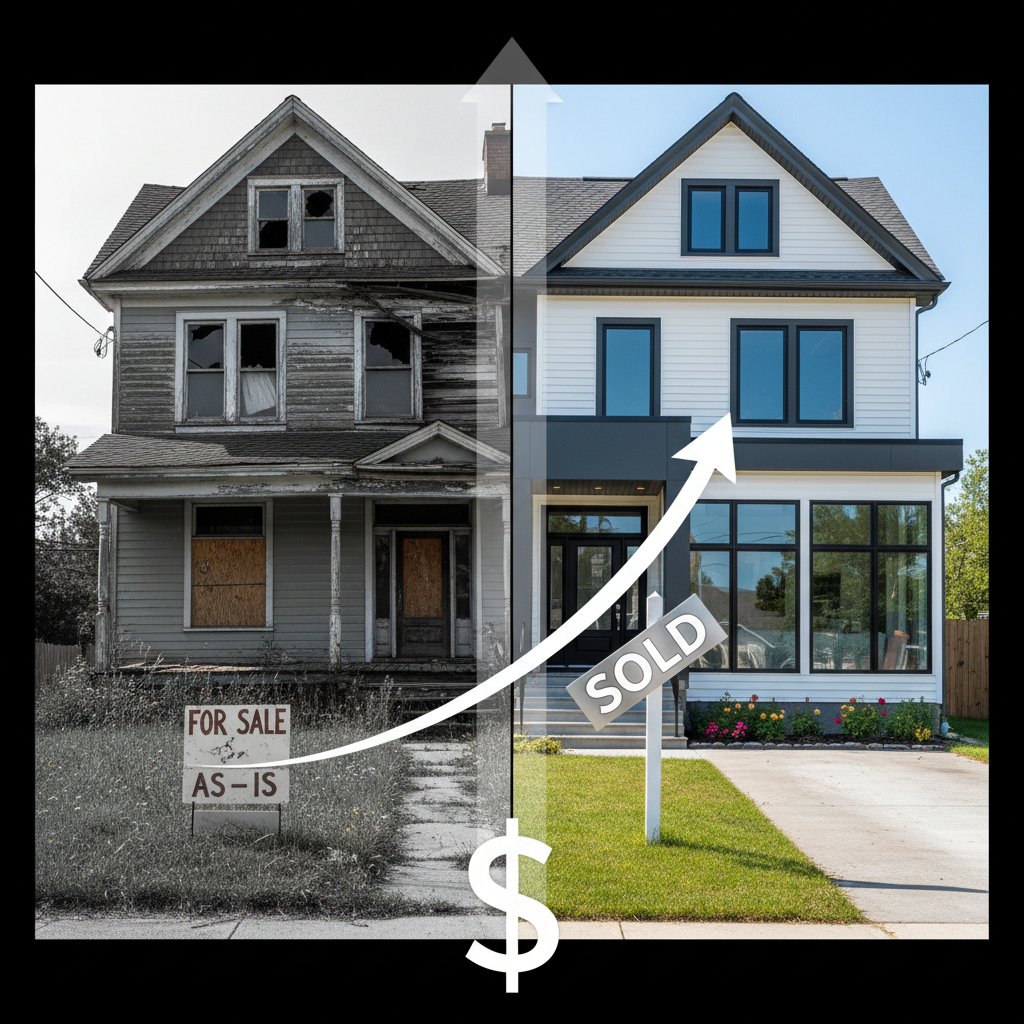
The decision to renovate a distressed property or sell it as-is is a cornerstone of profitable real estate investing. It's not a one-size-fits-all answer; rather, it hinges on a meticulous analysis of market conditions, property specifics, and your investment strategy.
For many pre-foreclosure and foreclosure acquisitions, the temptation to renovate for a higher ARV (After Repair Value) is strong. However, a deep dive into the numbers is paramount. Consider the '70% Rule' (investor pays no more than 70% of the ARV minus repairs) as a starting point. If your acquisition cost plus estimated repairs pushes you beyond this threshold, an as-is sale might be the more prudent path. "We've walked away from deals with great ARV potential because the repair costs, coupled with holding times, eroded our projected ROI," states Marcus Thorne, a veteran investor with 300+ flips under his belt. "Sometimes, the best renovation is no renovation at all."
**Key Factors Influencing the Decision:**
1. **Market Demand & Property Type:** In a hot seller's market with low inventory, even properties needing significant work can fetch a decent price as-is, especially from other investors or cash buyers. Conversely, in a slower market, a renovated property stands out. Luxury homes often require higher-end finishes to command top dollar, while entry-level homes might only need cosmetic updates. 2. **Repair Scope & Cost:** Distinguish between cosmetic updates (paint, flooring, fixtures) and structural/systemic issues (roof, foundation, HVAC, plumbing, electrical). The latter can be costly, time-consuming, and expose you to unforeseen problems, significantly impacting your timeline and budget. For example, a full kitchen remodel can easily run $30,000-$60,000, while a new roof might be $10,000-$25,000, depending on the property. 3. **Holding Costs & Timeline:** Every month a property sits, you're incurring taxes, insurance, utilities, and potentially loan interest. A lengthy renovation can quickly erode profits. If repairs are extensive, pushing the timeline beyond 3-4 months, the added holding costs might make an as-is sale more attractive. An as-is sale can often close in 2-4 weeks, versus 3-6 months for a full renovation and re-listing. 4. **Financing:** Lenders are often more conservative with properties requiring substantial repairs. If you're relying on hard money or private capital, their terms might favor a quicker, as-is exit to minimize interest accrual. 5. **Your Exit Strategy:** Are you targeting retail buyers or other investors? Retail buyers typically want move-in ready homes. Investors, however, are often looking for discounted properties they can renovate themselves.
"Understanding your buyer pool is critical," advises Sarah Jenkins, a real estate analyst specializing in distressed assets. "If your target is a cash investor, an as-is sale at 65-70% of market value might be more appealing than a full renovation that only yields a 10-15% higher ARV after all expenses and time are factored in."
Ultimately, the decision demands rigorous financial modeling and a clear understanding of your risk tolerance. Don't let emotion drive your investment choices.
Ready to sharpen your deal analysis skills and master the art of profitable real estate investing? Explore The Wilder Blueprint's advanced training programs for in-depth strategies and frameworks.